
Injury Law,
Done Personally
Done Personally




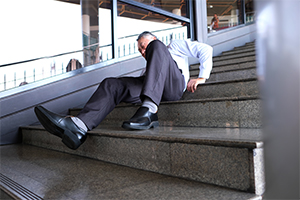
Slip and fall accidents are often dismissed as minor or unavoidable.
In reality, many of these incidents happen because a property owner failed to maintain safe conditions—and those failures can cause serious, life-altering injuries.
If you have been injured in a fall, your case may be about much more than a single step, surface, or moment.
It may be about long-term neglect, unsafe conditions, and violations of safety codes designed to protect you.
Slip and fall cases are often the result of dangerous property conditions such as:
In one case, an engineering expert determined that a fall occurred because a stairway tread failed completely during normal use, causing the person to fall instantly.
That type of failure is not random—it is preventable.
Under Louisiana law, property owners have a duty to:
When they fail to do so, they can be held responsible for injuries that result.
This area of law is called premises liability.
But proving a premises liability case requires more than showing that you fell. It requires showing:
This is where many cases are won or lost.
In the engineering report reviewed, the expert found:
Even more importantly, the expert concluded:
The dangerous condition was long-term, visible, and should have been recognized by reasonably attentive management.
That is the difference between:
Property owners cannot ignore deterioration.
In this case, there was evidence of:
These are not hidden defects.
These are conditions that:
Slip and fall cases are often governed by safety rules found in:
These rules require that:
When these rules are violated, it can be powerful evidence of negligence.
At Salter Law, we do not treat slip and fall cases as minor claims.
We investigate them thoroughly to determine why the fall happened.
We gather:
We work with engineers and safety experts to determine:
One of the most important issues in a premises case is whether the property owner knew or should have known about the condition.
We focus heavily on:
“I just fell—it must be my fault.”
Not necessarily. If a dangerous condition caused your fall, the property owner may be responsible.
“There was no warning sign.”
That may support your case—but even more important is whether the condition should have been fixed.
“It was just a step or stair.”
Structural failures—like a stair giving way—are often the result of long-term neglect.
If you were injured due to unsafe property conditions, you may be entitled to compensation for:
When you hire Salter Law:
We keep our caseload small so we can fully investigate each case and build it the right way.
If you have been injured in a fall, there may be more to your case than you realize.
The difference often comes down to whether the dangerous condition is fully investigated—and proven.
We are here to help you understand your rights and determine the best path forward.
Seek medical attention immediately, report the incident to the property owner or manager, and document the scene with photos if possible. It is important to speak with an attorney quickly, as evidence such as surveillance footage and maintenance records may not be preserved unless requested.
You must prove that a dangerous condition existed, the property owner knew or should have known about it, the condition caused your fall, and the owner failed to take reasonable steps to fix or warn about it.
A dangerous condition can include broken stairs, loose flooring, structural defects, wet or slippery surfaces, poor maintenance, a faulty handicap ramp, obstructions in walkways or any condition that creates an unreasonable risk of harm. In some cases, structural failures—such as a stair collapsing—are evidence of long-term neglect rather than a sudden issue.
This is called “notice.” It can be proven by showing the condition existed long enough that it should have been discovered, that it was visible, or that prior repairs or complaints were made. Expert analysis often helps show the condition developed over time and was not new.
Yes. Violations of building codes, safety standards, or maintenance requirements can be strong evidence of negligence. For example, property owners are required to maintain stairways and structures in a safe condition and capable of supporting normal use.
They can be challenging because the burden is on the injured person to prove the property owner’s fault. However, strong evidence—especially expert analysis showing unsafe conditions and code violations—can significantly strengthen a case.
Deadlines are strict under Louisiana law. You should speak with an attorney as soon as possible to protect your claim and preserve evidence.
In many cases, yes. Engineers and safety experts can determine whether a structure was safe, whether it violated codes, and whether the condition existed long enough that it should have been repaired. At Salter Law, we have worked with many different premises experts and know how critical it is for our clients to be connected with the right experts to help prove their case at trial.